Timebase Components
Introduction to the Timebase Platform
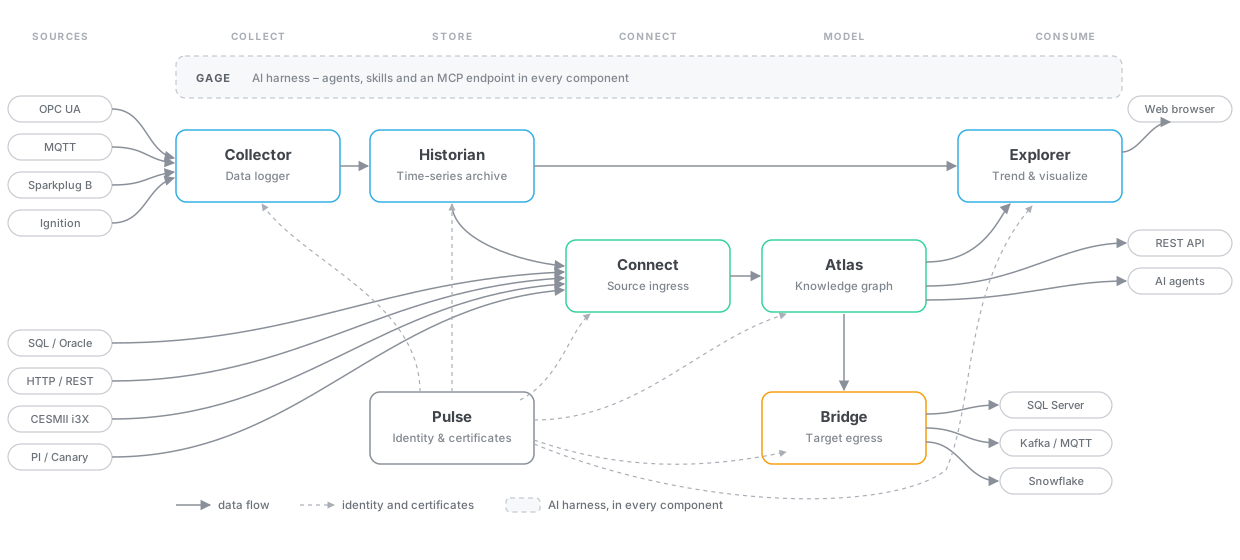
Timebase is made up of the following components. Pulse comes first, because everything else depends on it. After that the list follows the data: it is collected from the field, stored, given meaning, and then read or forwarded on.
Pulse - identity, certificates and licensing for everything else, and the single gateway to the LLMs that Gage uses. Every other component depends on it.
Collector - logs your real-time data sources into the Historian: MQTT, SparkplugB, OPC UA, Telegraf and more. One Collector connects to one data source.
Historian - the time series historian, providing high performance ingestion and lossless retrieval. This is where your data lives.
Explorer - trending and visualization: how you see and understand what has been stored.
Connect - sits between Atlas and your other systems - historians, SQL databases, OPC UA, HTTP - so a property on an Atlas model can be bound to live data that lives outside Timebase.
Atlas - models your plant as a knowledge graph, so that data in other systems becomes a typed property of a named asset: something you can ask questions about, instead of a value you have to go and find.
Bridge - publishes your Atlas models out to other targeted databases and systems, such as SQL Server, Snowflake, Kafka or MQTT.
Two of these are not stops on the journey but layers across all of it, which is why the diagram draws them apart from the flow.
Gage is the AI harness, and it ships in every component rather than being something you install beside them. Each one carries its own agents and skills, and each one serves an MCP endpoint at /mcp on its own address - so an AI agent can work with the Historian's tags, Atlas's graph or a Collector's configuration directly. Those endpoints are authenticated, not open. See Historian MCP Server and Atlas MCP Server.
Pulse sits under all of them. It issues the certificates components use to trust each other, checks the identity of callers, and brokers the language models Gage calls - no component holds a model API key of its own. See Configuring Gage LLM providers and models.